
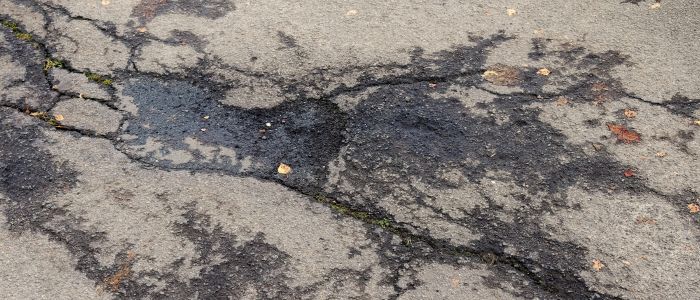
Common Signs of Asphalt Pavement Failure (and What They Mean)
Whether you manage a shopping center, medical complex, HOA property, or commercial parking lot, understanding the signs of asphalt pavement failure is critical to preserving your investment and avoiding costlier repairs later.
Asphalt starts deteriorating long before it collapses. If you can recognize asphalt pavement distress symptoms early, you can address problems with timely pavement maintenance, preventing water intrusion, base weakening, and structural failure.
Below are the most common signs of asphalt pavement failure, why they happen, and what they mean for your lot.
1. Cracking Patterns
Cracking is one of the most visible and telling asphalt pavement failure signs.
Types of Cracks You’ll See
Alligator / Fatigue Cracking –A series of interconnected cracks that look like reptile skin. This means the pavement structure is stressed under heavy loads and requires repair.
Longitudinal Cracks – Straight line cracks running parallel to traffic. Often caused by asphalt shrinkage or weak joints.
Transverse Cracks – Cracks that stretch across the pavement and signal temperature fluctuations, cycling stress through the surface.
Edge Cracks – Found along the pavement edge where there’s poor support or drainage.
These crack patterns are not cosmetic. They are early indicators that water and freeze‑thaw cycles are getting under the surface, weakening base layers, and allowing potholes to form.
2. Potholes
A pothole is not a standalone issue; it’s the result of ongoing asphalt deterioration.
Moisture seeps into cracks. Water freezes and expands. Repeated freeze‑thaw cycles weaken the base layer beneath the surface. Traffic then breaks away chunks of pavement, forming depressions.
If you see potholes in your lot, that’s a clear sign your pavement has moved past minor distress symptoms into structural failure territory. Immediate patching and assessment are recommended.
3. Raveling and Surface Erosion
Raveling describes when the surface aggregate starts to come loose, leaving a gritty, rough texture.
This usually begins as tiny particles dislodging and progresses into larger chunks breaking off. Raveling is one of the key asphalt distress indicators Boise property managers should watch for because it typically means:
The asphalt binder is oxidizing
Surface oils are gone
The pavement is losing flexibility
Without preservation treatments like asphalt rejuvenation or crack sealing, raveling accelerates cracking and potholes.
4. Rutting and Depressions
Rutting shows up as grooves or channels in the wheel paths where vehicle traffic regularly travels. This is typically a symptom of:
Heavy loads compressing the surface
Weak base layers
Insufficient compaction during installation
Left unchecked, rutting leads to water pooling after rain, which dramatically accelerates asphalt failure.
5. Shoving and Edge Breaks
Shoving is a localized displacement of asphalt, typically caused by braking or turning forces, where the pavement literally “mounds up.” Edge breaks happen when the pavement edge is not properly supported or drained.
Both are structural pavement failure symptoms that indicate the load‑bearing capacity of the asphalt has been compromised.
6. Poor Drainage and Water Pooling
Water is the enemy of pavement.
Pooling water accelerates oxidation and helps cracks widen. Where water lingers, freeze‑thaw cycles do more damage, and that’s when minor cracks escalate into larger failures.
If you regularly see water pooling after rain, your lot isn’t just experiencing aesthetic issues; it’s showing early signs that asphalt failure could be imminent without proper drainage improvement.
When to Act: Inspection and Maintenance Tips
Recognizing the signs of asphalt failure is just the first step. To protect your lot:
Schedule regular parking lot inspections at least twice a year
Address small cracks before they spread
Keep debris and water off the surface with scheduled sweeping
Consider asphalt rejuvenation or crack sealing to restore surface oils and delay oxidation
Plan repairs before heavy seasonal weather hits
Early intervention means longer pavement life, fewer costly repairs, and better safety for customers and staff alike.
Why Local Insight Matters (Boise & Treasure Valley)
Boise’s unique climate, wind, spring rain showers, hot summers, and seasonal freeze‑thaw cycles accelerate many of these failure patterns more quickly than in milder climates. That’s why local knowledge of asphalt pavement distress symptoms for Boise property owners should be a priority in any property maintenance plan.
When to Call the Experts
Some symptoms, like minor cracking, can be managed with crack filling and rejuvenation. Others alligatoring, rutting, and water damage, often require professional evaluation and repair.
If your lot is showing one or more of the common signs listed above, it’s time for a professional assessment. Proper parking lot repair Boise services prioritize long‑term performance, not just quick fixes.
Call or text BlakRoc at (208) 409-8007. Serving Boise, Meridian, Nampa, Eagle & the surrounding Treasure Valley. If you haven’t already, follow us on Instagram for more asphalt content!
Call or text BlakRoc at (208) 409-8007. Serving Boise, Meridian, Nampa, Eagle & the surrounding Treasure Valley.
If you haven’t already, follow us on Instagram for more asphalt content!