

Pavement Condition Index (PCI) for Property Teams; Score, Track, Act
If you manage a property, whether it’s a commercial parking lot, HOA neighborhood, or residential driveway, you already know asphalt doesn’t stay perfect forever. But how do you know when to take action, and how bad your pavement really is?
That’s where the Pavement Condition Index (PCI) comes in.
The PCI provides property owners with an objective, easy-to-understand score that indicates how their pavement is performing and when it’s time to maintain, repair, or replace it.
What Is the Pavement Condition Index (PCI)?
The Pavement Condition Index (PCI) is a standardized rating system, ranging from 0 to 100, used across the U.S. to measure pavement health.
100 = brand new or excellent condition
0 = failed pavement
It’s based on a visual inspection of the surface. Inspectors or contractors look for common forms of distress, things like cracks, raveling, potholes, rutting, and edge wear, and assign severity levels (low, medium, or high). Each type of damage slightly reduces the PCI score until you get an overall number that reflects your pavement’s condition.
Why PCI Matters for Property Owners
Even though PCI started as a government engineering tool, it’s now one of the most practical ways for private property teams to manage their pavement proactively.
Objective data: Instead of relying on guesswork or visual estimates, PCI gives you a measurable condition score.
Budget planning: Knowing your PCI helps you prioritize which areas to maintain first and plan for future repair costs.
Maintenance timing: Pavement in the “Good” range (70–84) can often be preserved with crack sealing or rejuvenation—long before costly reconstruction is needed.
Documentation: For commercial properties, PCI scores create a record that supports capital budgets, insurance needs, and vendor accountability.
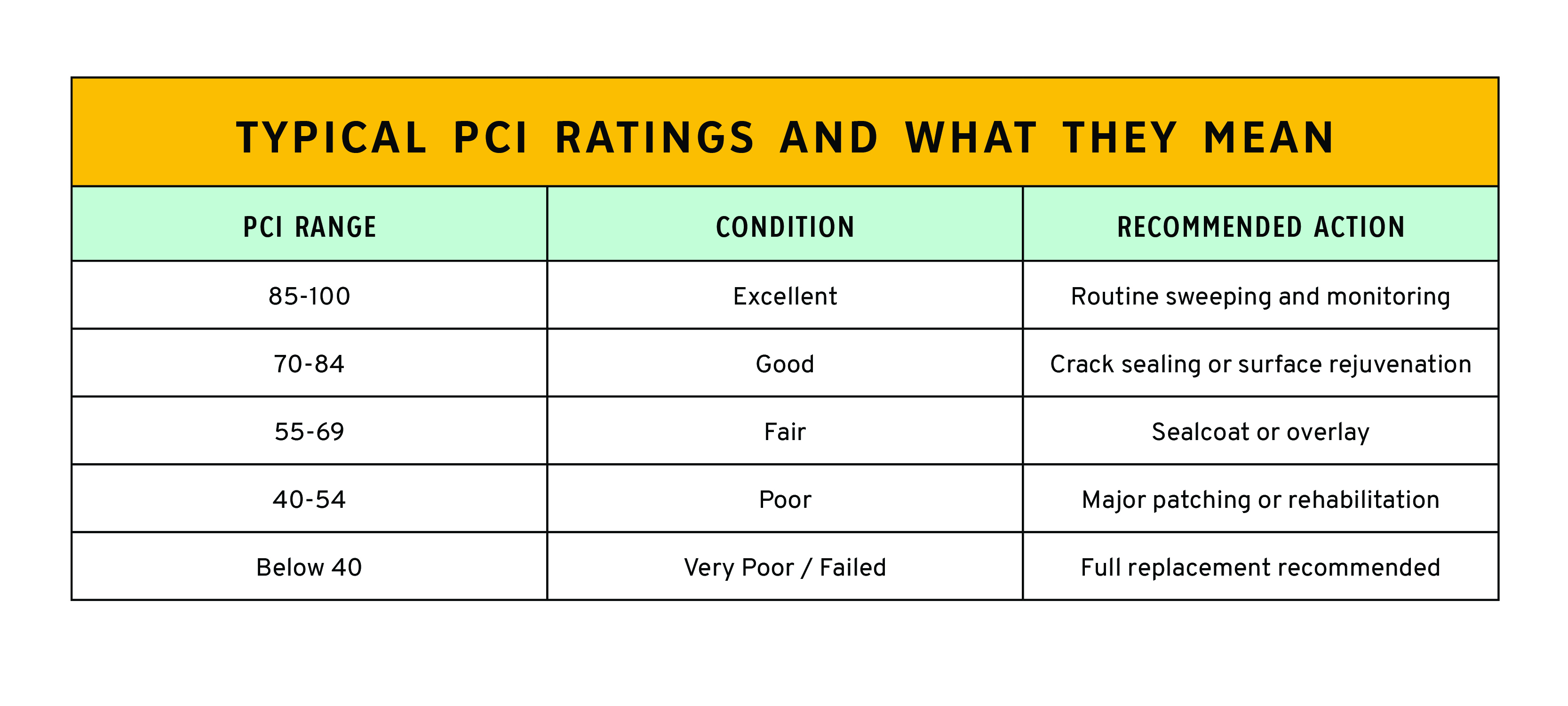
If your pavement falls below the “Good” range, maintenance costs start increasing exponentially. A small crack at PCI 80 can often be fixed in minutes, but left unchecked, that same area might require major repairs once it drops into the 50s.
How to Use PCI to Assess Your Pavement
You don’t need a government engineer to start tracking PCI. Property owners can use a simplified version to monitor conditions year-round:
Walk your pavement regularly. Look for cracks, standing water, faded striping, or surface wear.
Assign a general score:
Looks nearly new? → PCI 90–100
Some cracks or wear? → PCI 70–85
Visible ruts or pooling? → PCI 50–70
Potholes or large failures? → PCI <50
Record your findings: Keep notes or photos every season.
Contact a professional: A BlakRoc pavement assessment can provide an accurate PCI rating and a plan to extend the life of your surface.
Tracking PCI once or twice a year turns maintenance into a manageable, predictable task instead of a surprise expense.
And, if you haven’t already, follow us on Instagram for more asphalt content!