The Property Manager's Guide to Asphalt Rejuvenation
If you manage commercial property in Boise and your parking lot is looking gray, brittle, or starting to surface crack, asphalt rejuvenation is likely the most cost-effective treatment available to you right now. But it's also one of the most misunderstood services in the pavement maintenance industry.
This guide covers everything you need to know to make a confident, informed decision about whether rejuvenation is right for your lot.
WHAT ASPHALT REJUVENATION ACTUALLY IS
Asphalt pavement is held together by a binder called bitumen, which contains natural oils called maltenes. These oils give asphalt its flexibility, its dark color, and its ability to handle traffic and temperature changes without cracking. From the day pavement is laid, UV rays and oxygen begin stripping those oils away through oxidation.
The result is pavement that turns gray, becomes brittle, and starts to crack, not because it's structurally failing, but because it's drying out.
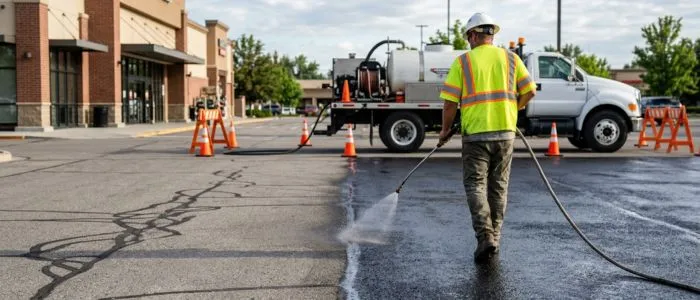
Asphalt rejuvenation works by applying a penetrating agent to the pavement surface that soaks into the asphalt binder and chemically restores the depleted maltene oils. It treats the cause rather than the symptom, restoring flexibility and extending pavement life from the inside out rather than coating the surface from the top down.
HOW IT DIFFERS FROM SEALCOATING
This is the question we get most often.
Sealcoating applies a protective layer on top of the pavement surface. It's a coating — like paint on wood. It protects against UV and light wear but does not penetrate the asphalt or address binder depletion beneath the surface.
Rejuvenation penetrates the pavement and restores what oxidation has removed. It's the right treatment when the pavement has already oxidized and needs restoration, not just protection.
For pavement in good condition with minimal oxidation, sealcoating makes sense as a preventive measure. For pavement that has gone gray, lost flexibility, and started to crack at the surface, rejuvenation is the treatment that actually fixes the problem.
HOW TO TELL IF YOUR LOT QUALIFIES
Not every lot is a rejuvenation candidate. Here's how to assess yours.
Good signs for rejuvenation:
Surface has turned gray or chalky
Minor surface cracking — isolated, not widespread
Pavement still feels firm and solid underfoot — no soft spots or flex
No alligator cracking or large connected fracture patterns
Lot is between 5 and 15 years old with no major structural events
Signs the damage may be too advanced:
Widespread alligator cracking across large sections
Soft spots or areas that flex underfoot
Significant pothole formation
Crumbling edges or exposed base material
The line between "qualifies for rejuvenation" and "needs repair or replacement" is the condition of the sub-base beneath the surface. If the base is sound, rejuvenation can deliver excellent results. If the base is compromised, no surface treatment will hold — and a professional assessment is the only reliable way to know which situation you're in.
WHAT THE PROCESS LOOKS LIKE
A professional asphalt rejuvenation service typically follows this sequence:
1. Assessment: A thorough evaluation of surface condition, crack severity, base integrity, and drainage before any work begins. This determines whether the lot qualifies and what additional prep work is needed.
2. Sweeping: The surface is thoroughly cleared of all debris, sand, and loose material. The rejuvenating agent needs direct contact with the pavement surface to penetrate effectively.
3. Crack fill: Existing cracks are cleaned and filled before treatment. Sealing cracks before rejuvenation prevents water intrusion and allows the treatment to deliver its full benefit.
4. Application: The rejuvenating agent is applied evenly across the pavement surface, where it begins to penetrate the asphalt binder.
5. Cure: The lot is closed to traffic for a short period, typically a few hours, while the treatment cures. Full penetration and bonding take 24–48 hours, during which sharp vehicle turns should be avoided where possible.
HOW LONG DOES IT LAST?
In Boise's climate, a professionally applied rejuvenation treatment on qualifying pavement typically extends lot life by 5–8 years, depending on pavement age and condition at the time of treatment and subsequent maintenance practices.
Boise's high UV intensity and freeze-thaw cycle mean pavement here ages faster than in many other markets. A lot that might hold up without treatment for 8 years in a milder climate may need attention in 5–6 years in the Treasure Valley. Rejuvenation applied at the right point in that cycle, before cracking becomes widespread, delivers the best return.
Ongoing maintenance after rejuvenation- regular sweeping, prompt crack fill as needed, drain management- extends the benefit further.
WHAT IT COSTS COMPARED TO ALTERNATIVES
Asphalt rejuvenation costs significantly less than full pavement replacement, which runs $3–7 per square foot for commercial lots in the Treasure Valley. On a 20,000 square foot lot, that's $60,000–$140,000.
Rejuvenation costs a fraction of that, and when applied to pavement that genuinely qualifies, it can defer replacement by years, sometimes by a decade or more.
The relevant comparison isn't rejuvenation vs. sealcoating; it's rejuvenation vs. replacement. When the sub-base is sound, and the surface has oxidized but not structurally failed, rejuvenation is almost always the smarter financial decision.
QUESTIONS WORTH ASKING BEFORE YOU BOOK
Before hiring any contractor for rejuvenation, ask these:
Will you assess my base before recommending treatment?
How do you determine whether my lot qualifies?
What does the job include: sweeping, crack fill, application?
What are the traffic restrictions and cure times?
What should I expect in terms of appearance after treatment?
A contractor who can answer all of these clearly and specifically is worth trusting.
BlakRoc provides free pavement assessments for commercial properties across Boise, Meridian, Nampa, Eagle, and the greater Treasure Valley. We assess base integrity, surface condition, and oxidation stage before recommending any treatment, and we'll always tell you honestly if rejuvenation isn't the right call for your lot.
📞 (208) 409-8007 🌐 blakroc.com 📍 Proudly serving Boise and the Treasure Valley
If you haven’t already, follow us on Instagram for more asphalt content!