
What Is Sub-Base Failure and How Do You Know If Your Lot Has It?
Most visible parking lot damage starts at the top and works its way down. Sub-base failure is the opposite. It starts underneath and works its way up. By the time you can see it clearly on the surface, the damage has usually been developing for years.
Understanding what sub-base failure is, what causes it, and how to catch it early is one of the most valuable things a commercial property manager can know about their parking lot.
WHAT IS THE SUB-BASE?
Asphalt pavement is not just a single layer of material. It's a system.
At the bottom is the native soil, the ground your lot sits on. Above that is the sub-base, typically a layer of compacted gravel or crushed stone that provides a stable, load-bearing foundation for everything above it. On top of the sub-base sits the base course, and above that is the asphalt surface layer you can see and drive on.
The sub-base is what gives your parking lot its structural strength. It distributes the load of vehicles across a wide area so the asphalt above doesn't crack or deform under pressure. When it's intact and properly compacted, your lot can handle years of traffic without structural problems.
When it fails, everything above it eventually fails too.
WHAT CAUSES SUB-BASE FAILURE?
Water infiltration: This is the most common cause, and the most preventable. Water enters through surface cracks, drains poorly due to blocked lot drains, or accumulates at the pavement edges. Once water saturates the sub-base material, it loses its load-bearing strength. The compacted gravel that was supporting your pavement becomes soft and unstable.
In Boise's climate, water infiltration combined with the freeze-thaw cycle is particularly destructive. Water in the sub-base freezes and expands in winter, displacing material and creating voids beneath the pavement surface. When it thaws, the asphalt above settles into those voids unevenly.
Inadequate original construction: Sub-base failure can originate from the initial installation, insufficient thickness, poor compaction, or the wrong material for the soil conditions beneath. This type of failure often shows up earlier than expected and doesn't respond well to surface treatments because the problem was never in the surface to begin with.
Overloading: Sub-bases are engineered for specific load ratings. Construction vehicles, heavy delivery trucks, and overloaded equipment regularly exceed those ratings. In Boise's high-growth corridors, where construction traffic has dramatically increased over the last several years, properties near active job sites face load stress that their sub-base wasn't designed to handle.
Age and material degradation: Over time, sub-base material can degrade, shift, or settle unevenly. This is a normal part of pavement aging but is significantly accelerated by the factors above.
HOW TO TELL IF YOUR LOT HAS SUB-BASE FAILURE
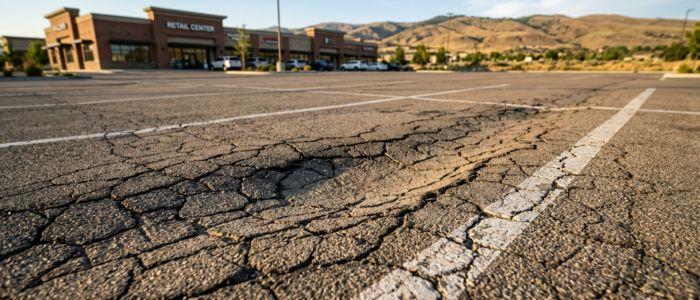
Alligator cracking: This is the most recognizable sign. Alligator cracking — the interconnected, web-like pattern of cracks that resembles reptile scales — forms when the asphalt surface has nothing solid supporting it and begins to fracture under load. It almost always indicates sub-base failure beneath. Surface treatments do not fix alligator cracking. The cause is below the surface.
Soft spots or flex underfoot: Walk your lot and pay attention to how the pavement feels. Healthy asphalt over a sound sub-base feels firm and unyielding. Pavement over a compromised sub-base may flex slightly or feel spongy underfoot — particularly after rain or during warmer months when the sub-base material has absorbed moisture.
Potholes that keep coming back: If a pothole has been patched multiple times and keeps returning in the same location, the patch isn't the problem. The sub-base beneath that section is failing and patching the surface without addressing it is temporary at best. The pothole will return as long as the base beneath it remains compromised.
Uneven or sunken sections: Areas of the lot that have settled lower than surrounding pavement, particularly near drains, at lot edges, or where heavy vehicles turn, can indicate sub-base voids or material displacement beneath the surface.
Water pooling in unexpected areas: If water consistently pools in areas that aren't near drains and the lot appears level, the pavement below may have settled unevenly due to sub-base movement.
CAN SUB-BASE FAILURE BE REPAIRED?
Yes, but the repair is more involved than surface treatments.
Depending on the extent of the failure, repair options range from full-depth reclamation of the affected section to complete base reconstruction followed by new asphalt. In some cases, sections of the lot can be addressed individually rather than requiring full replacement of the entire surface.
What doesn't work is applying surface treatments, rejuvenation, sealcoating, or crack fill over sections with confirmed sub-base failure. These treatments address surface conditions. They cannot stabilize a compromised foundation. Money spent on surface treatments over a failing base is money that won't deliver lasting results.
A professional assessment that goes beyond the surface- checking base integrity, looking for soft spots, understanding drainage patterns- is the only way to know what you're actually dealing with and what the right repair is.
WHY EARLY DETECTION MATTERS
Sub-base failure is one of those problems where timing significantly changes the cost of the solution.
Caught early, when soft spots are developing but the surface above is still largely intact, targeted section repair is often possible. The damage is contained, the repair is specific, and the cost is manageable.
Left until alligator cracking has spread across large sections and multiple areas of the lot are failing structurally, the scope of repair expands dramatically. In some cases, deferred sub-base failure turns what could have been a targeted repair into a full lot replacement conversation.
The freeze-thaw cycle in Boise accelerates this timeline. A soft spot that develops in late summer can become a significantly larger structural problem after a single winter of freeze-thaw cycles working on the compromised material below.
GET A FREE ESTIMATE FROM BLAKROC
If your lot has any of the signs described above, soft spots, alligator cracking, recurring potholes, or uneven sections, a professional assessment is the right next step. BlakRoc evaluates surface condition and base integrity for commercial properties across Boise, Meridian, Nampa, Eagle, and the greater Treasure Valley at no charge.
We'll tell you honestly what's happening and what it will take to fix it.
BlakRoc provides professional parking lot sweeping for commercial properties across Boise, Meridian, Nampa, Eagle, and the greater Treasure Valley.
📞 (208) 409-8007 🌐 blakroc.com 📍 Proudly serving Boise and the Treasure Valley
If you haven’t already, follow us on Instagram for more asphalt content!