
When Is It Too Cold to Seal Asphalt Cracks in Boise? | BlakRoc
If you're managing a commercial property in Boise and wondering whether you've still got time to get cracks sealed before winter, the answer depends on one number: 50°F.
That's the minimum ambient temperature required for most crack sealants to bond properly to asphalt. Below that threshold, the material doesn't flow correctly, adhesion is compromised, and the seal won't hold through a Boise winter. You'd be spending money on a repair that fails before spring.
BOISE'S SEALING WINDOW
In the Treasure Valley, ambient temperatures typically drop below 50°F consistently in mid to late October. That makes September and early October the practical end of crack sealing season, and the window narrows fast once nights start getting cold, even if afternoons are still warm.
Here's why that matters: sealant needs the ambient temperature to be above 50°F not just during application but through the initial cure period. A warm afternoon with a 40°F night can compromise a seal that appeared fine when it was applied.
For most Boise properties, the realistic deadline for crack sealing is mid-October. September is the sweet spot; temperatures are cooperative, the days are still long, and you're not racing the forecast.
Yes, and it's worth understanding the difference.
Ambient temperature is the air temperature. Pavement surface temperature is what the asphalt itself registers, and on a sunny fall day in Boise, surface temps can run 10–20°F warmer than the air. An experienced contractor monitors both.
Cold pavement makes sealant viscous and difficult to work with. It reduces penetration into the crack walls, which is where adhesion actually happens. Even if the air temp is marginal, cold pavement can result in a seal that looks complete but hasn't bonded properly.
WHAT HAPPENS IF YOU WAIT TOO LONG
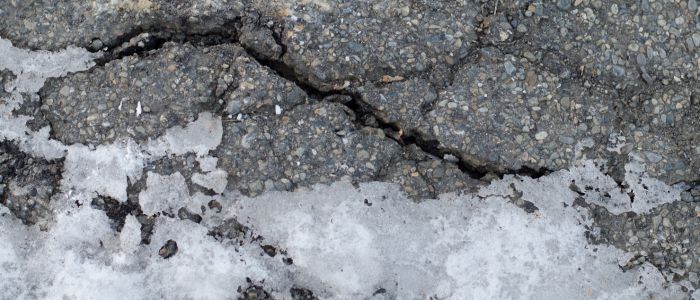
Cracks that go unsealed through a Boise winter take a predictable path. Water enters the crack, freezes, expands, and forces the crack wider, sometimes dramatically. By the time temperatures rise enough to seal again in spring, what was a hairline crack in September has become a structural problem.
The cost difference between sealing a crack in September and repairing the damage it causes over winter is significant. The work that costs a few hundred dollars in fall can easily become a few thousand by spring.
CAN ANYTHING BE DONE IN THE WINTER?
In some cases, yes, but with limitations.
Cold-pour crack fillers are designed for lower-temperature applications and can be used in conditions where standard hot-pour sealant won't perform. They're a temporary measure, not a permanent fix, and they don't deliver the same longevity as a proper hot-pour seal applied in the right conditions.
If cracks develop or worsen over winter, cold-pour filler can prevent further water intrusion until conditions allow for a proper repair in spring. It's better than nothing, but it's not a substitute for sealing before the cold arrives.
If your Boise or Treasure Valley parking lot has cracks that need attention, September is when to act. October is possible, but the window gets narrow fast. By November, the season is effectively over for most sealant applications.
BlakRoc provides professional crack sealing and pavement maintenance for commercial properties across Boise, Meridian, Nampa, Eagle, and the greater Treasure Valley.
📞 (208) 409-8007 🌐 blakroc.com 📍 Proudly serving Boise and the Treasure Valley
BlakRoc Asphalt Maintenance provides professional parking lot striping, asphalt rejuvenation, crack repair, sweeping, and full-service pavement maintenance for commercial properties throughout the Treasure Valley.
If you haven’t already, follow us on Instagram for more asphalt content!